


Windows Central Verdict
The 14-inch Slim 7i stands as one of my all-time favorite Windows laptops, and the Ultra Aura Edition (Gen 11) carries over much of what I valued in its predecessors. With Panther Lake, this ultra-lightweight PC lasts all day (and beyond), but I'd happily trade some of its battery life for the higher-end Core Ultra X7/X9 processors that Lenovo currently offers outside the US. With the Core Ultra 7 355, it'll still have tremendous appeal towards frequent travelers.
Reasons to buy
- +
Beautifully lightweight at only 2.15lbs / 975g
- +
Outrageous battery life reaches 18+ hours in testing
- +
Haptic touchpad with a smooth glass finish
Reasons to avoid
- -
Price increases and model availability issues since launch
- -
Too much pre-installed software and advertisements
- -
No USB-A, headphone jack, or HDMI ports
Why you can trust Windows Central Our expert reviewers spend hours testing and comparing products and services so you can choose the best for you. Find out more about how we test.
Lenovo's "Aura Edition" subcategory continues its unique partnership with Intel, featuring a line of Windows devices that lean heavily into the AI PC trend. At its surface, that's what this is: an Intel-powered laptop with smart software tweaks, but most of the magic usually comes from the Core Ultra processor inside and the chassis around it.
• Lenovo Yoga Slim 7i Ultra (Gen 11) Aura Edition for $1,889.99 at Lenovo USA
It's tricky to explain in a nutshell, so I tested the new Yoga Slim 7i Ultra (Gen 11) Aura Edition to go hands-on with an example — and to find out what's up with the specs and pricing. The US is missing the same flexible processor options I can access in the UK, and prices are fluctuating for Americans, too.

I traveled around the world with a Slim 7i 14 (Gen 9), and it quickly became my favorite laptop. Now, I'm eager to see if Lenovo can win me back from the charms of ASUS' Zenbook. I've put these PCs through real-world tests.
How much does the Slim 7i Ultra Aura Edition cost?

Lenovo estimated the Yoga Slim 7i Ultra Aura Edition (Gen 11) would start at $1,499.99 USD when it announced the laptop at CES 2026, but that optimistic price has turned out to be closer to $1,629.99 $1,889.99 for a configured version on Lenovo's storefront (the price increased as I wrote this). Using the "Build Your PC" option, you can upgrade from Windows 11 Home to Pro for $50 and from 1TB to 2TB of storage for $190.
Whether you push to $1,869.99 $2,129.99 by upgrading its two customizable components will depend on personal preference and individual use cases. Otherwise, we're looking at a $130 $390 price increase since we saw the Yoga Slim 7i Ultra Aura Edition announcement in January.
In the United Kingdom, Lenovo starts the Yoga Slim 7i Ultra Aura Edition at £2,010, but you get more customization options. Crucially, you can choose from three of Intel's Core Ultra Series 3 "Panther Lake" processors: a Core Ultra 5 325, a Core Ultra 7 355, and finally, a Core Ultra X9 388H with upgraded Intel Arc B390 integrated graphics for an extra £250.
Component |
Spec |
|---|---|
CPU |
Intel Core Ultra 7 Processor 355 |
RAM |
32 GB LPDDR5X-7467MT/s |
GPU |
Intel Graphics (Integrated) |
Display |
14" 16:10 2.8K (2880 x 1800) touch |
Storage |
1 TB SSD M.2 2242 PCIe Gen4 TLC |
Battery / Charger |
75Whr / 65W USB-C |
Weight |
2.15 lbs / 975 g |
Is the Slim 7i Ultra Aura Edition a good laptop?


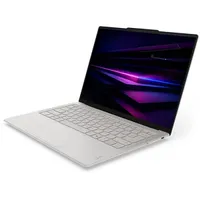
At 2.15 lbs, this is one of the lightest 14-inch Windows laptops I've ever carried. Lighter than ASUS' Zenbook A14 (2.18 lbs) and Apple's 13-inch M5 MacBook Air (2.7 lbs), the magnesium-aluminum chassis still keeps it feeling solid and sturdy despite its featherweight build. The "thixomolding" procedure for its shell also means it feels particularly similar to the "Ceraluminum" ASUS used on standouts like the 14-inch Zenbook S 14, if slightly more glossy.
Just like the Slim 7i (Gen 9) I loved so much before it, this Aura Edition is a joy to use.
The 5.5-inch glass haptic touchpad also makes this laptop stand out from all the mechanical equivalents I've used before, though I'm not sure the technology proved to be quite as life-changing as I expected. Still, cursor control is smooth and responsive, complementing the deep 1.5mm key travel I expect from Lenovo's laptops. Just like the Slim 7i (Gen 9) I loved so much before it, this Aura Edition is a joy to use.


The webcam resides in a wide bar that slightly protrudes from the chassis, doubling up as a lip on the top lid that helps with single-finger opening. It's a great camera, and the speakers follow suit with impressive bass response in a setup with 2 woofers and 2 tweeters. An IR sensor enables Windows Hello for face-enabled logins and Human Presence Detection (HPD) that can blur my screen if "Shield Mode" is activated in Lenovo's Smart Modes via the F9 key.
Battery life on the Slim 7i Ultra Aura Edition borders on the absurd, reaching over 18 hours.
There's a webcam shutter switch on the right side if you'd rather disable the camera altogether, though I quite enjoy using a "wake on approach" method with HPD enabled. Battery life on the Slim 7i Ultra Aura Edition borders on the absurd, reaching over 18 hours in PCMark 10 tests that emulate constant productivity app usage and video playback. For an x86-64 PC, it's an incredible feat and a display of Panther Lake's ability.
Finally, the 2.8K (2880 x 1800) OLED touchscreen reaches 511 nits without HDR in my colorimeter testing, and setting the brightness to 74% gives you a comfortable 250 nits. Without any tweaking, the display achieves 100% color accuracy in the sRGB and P3 gamuts, while AdobeRGB comes in shorter at 87%. It's a beautiful panel with strong contrast, offering a standard 60Hz refresh rate or a smoother 120Hz mode. Zero complaints here.
Does the Slim 7i Ultra Aura Edition have any issues?


Shrinking the hardware into this ultra-lightweight frame comes with I/O sacrifices. The Yoga Slim 7i Ultra Aura Edition excludes USB-A, HDMI-out, and headphone options, leaving three Thunderbolt 4 USB-C ports with 45–65W power delivery and DisplayPort-out 2.1 for compatible external monitors. On the bright side, there's no proprietary AC adapter, but my USB-A dongles all need a hub or conversion cable.
Software bloat is still a minor gripe on Lenovo devices, and I found the usual McAfee (and WebAdvisor by McAfee) preinstalled, along with a Dropbox Promotion and an Adobe Creative Cloud advertisement in the Start menu. There's also a web shortcut to the Lenovo Subscription Marketplace pinned to the taskbar, which, again, is little more than a baked-in ad. Disappointing, but ultimately all removable with some user effort.


Lenovo says the Slim 7i Ultra Aura Edition is "designed to deliver exceptional performance for gaming", but you'd need the higher-tier Core Ultra X processors and the more capable Intel Arc B390 integrated graphics to stand any chance of seeing evidence of that. With the standard integrated Intel Graphics in the Core Ultra 7 355 processor in my sample, Cyberpunk 2077 couldn't exceed an average of 26 FPS at its lowest settings.
Less demanding PC games wouldn't need such drastic graphics hardware, but that always feels like a cop-out. As hardware progresses, it's less and less interesting to see the likes of Minecraft advertised as running on modern laptops just to claim they're capable of PC gaming. Counter-Strike 2 couldn't reliably maintain more than 60 FPS on its lowest settings at 1680 x 1050 resolution, and the CPU climbed to 95°C, so gaming is off the table.
How fast is the Slim 7i Ultra Aura Edition?


Lenovo advertises the Aura Edition range with phrases like "standout design, uncompromised power". The former is undoubtedly true for the Yoga Slim 7i Ultra, but the latter is muddied by its selection of the Core Ultra Series 3 family of processors. You see, the Core Ultra 7 355 is the sole option for US buyers, who aren't as lucky as those over in the UK, as we can upgrade to a high-end Core Ultra X9 388H — the 'H' meaning "highest performance".
This laptop deserves at least a Core Ultra X7 358H to match its stellar design and promises, a choice referenced in Lenovo's product specifications reference sheet for the Yoga Slim 7i Ultra. It's not that the Core Ultra 7 355 in my US-based sample is bad, as it can match or surpass the Core Ultra Series 2 "Lunar Lake" chips found in the Yoga Slim 9i (Gen 10) and Yoga Slim 7i Aura Edition (Gen 9).
[Lenovo's] Yoga Slim 7x is extremely tempting — this laptop's biggest competitor is its sibling.
It does fall behind the Core Ultra 155H "Meteor Lake" chip from two generations prior, found in one of my favorites, the Slim 7i (Gen 9) — admittedly an apples-to-oranges CPU comparison for a laptop that retailed for around $1,240 at the time. Still, the Core Ultra 7 355 offers tremendous battery life, and this Ultra Aura Edition Gen 11 beats the Gen 9 in most other ways that count.
The elephant in the room is the absolutely incredible Yoga Slim 7x (Gen 11), powered by Qualcomm's Snapdragon X2 Elite processor, which serves as a Windows on ARM alternative to the somewhat more traditional x86-64 chips on offer in this Intel-based Yoga Slim 7i Ultra Aura Edition. There's no getting around it: the Yoga Slim 7x is extremely tempting, starting at just $1,099.99, and it comes from Lenovo itself. This laptop's biggest competitor is its sibling.
Should you buy the Slim 7i Ultra Aura Edition?

You should buy this if ...
✅ You want the lightest 14-inch Windows laptop
✅ You're a frequent traveler who relies on long battery life
You should not buy this if ...
❌ You use graphic-intensive apps; upgrades will be needed
❌ You rely on USB-A devices or wired headphones without adapters
An "estimated" $1,499.99 starting price certainly made this laptop more exciting when Lenovo announced it at CES earlier this year, and even a bump to $1,629.99 was one I could handle. However, when the company triggered a second increase to $1,889.99 while I was testing the Yoga Slim 7i Ultra Aura Edition, its limited processor options in the US became harder to accept.
The Core Ultra 7 355 is still a great example of Intel's Core Ultra Series 3 "Panther Lake" chips and the tremendous power efficiency they offer, but the Yoga Slim 7x and its Snapdragon X2 Elite chip are likely to draw many buyers away. It'll mean losing out on the haptic touchpad, lower display refresh rate, and the lightweight chassis, but I can't imagine that's enough. A tricky one.


Join us on Reddit at r/WindowsCentral to share your insights and discuss our latest news, reviews, and more.
