In March last year, flash storage manufacturer Exascend revealed its PE4 16TB M.2 2280 PCIe Gen4 NVMe SSD, the world's first solid-state drive to house 16TB of storage space.
It's a godlike SSD designed to empower data centers, high-end NAS systems, cutting-edge computers, and AI setups with a lifetime's supply of storage space and insanely high read speeds of up to 3270 MB/s.
Now, over a year later, the Exascend PE14 16TB SSD is available to purchase on Amazon for a shockingly steep MRSP of $15,935. If you want it for just shy of $16k (and I'm sure you do), you'll have to be fast, as there are only 9 remaining at the time of writing.
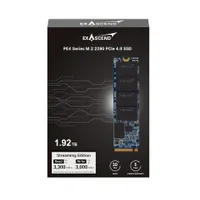
$16,000 for the Exascend PE14 16TB SSD does look like complete overkill, but that's only if you're looking to use it for personal use like casual browsing or PC gaming; that's what its lower-sized variants are for.
The Exascend PE4 16TB SSD is purely for larger, industrial-scale purposes like providing the servers of corporations with high-density storage space, running AI and Machine Learning systems with high I/O operations per second and low latency, and helping the latest, advanced computing process high-volume data effeciently.
So, if you're looking to keep all of your company's sensitive data secure or improve the work speed of AI programs, the Exascend PE14 16TB SSD could be for you.

The key selling points of the PE4 16TB SSD are:
- In addition to being the world's first 16TB SSD, the Exascend PE4 is available in 1TB, 2TB, 4TB, and 8TB capacities.
- It features monsterously quick sequential read speeds up to 3,270 MB/s and write speeds up to 2980 MB/s, so it can handle intense multitasking, 4K workflows, and 24/7 server environments.
- It is built with a 176-layer TLC 3D NAND and optimized for high performance per watt, with active power consumption below 7.2W, so it can operate at full capacity while keeping itself cool to prevent bottlenecks.
- The Exascend PE4 16TB SSD is extremely durable as it can reliably operate between 0°C and 70°C with a 2,000,000-hour Mean Time Between Failures, allowing it to work for days at a time without rest.
- Temperature-Proof & Long-Life Design – Built to operate reliably from 0°C to 70°C with an impressive 2,000,000-hour MTBF, ideal for 24/7 operation in workstations, servers, and NAS systems.
🗨️ How many are you buying?
What do you think of the Exascend PE4 16TB SSD? Would you ever seriously consider purchasing one, or are you waiting for a substantial price drop before committing?
If you have any thoughts on the matter, please let us know through the poll below, the comments section, or via our Reddit community.

Join us on Reddit at r/WindowsCentral to share your insights and discuss our latest news, reviews, and more.