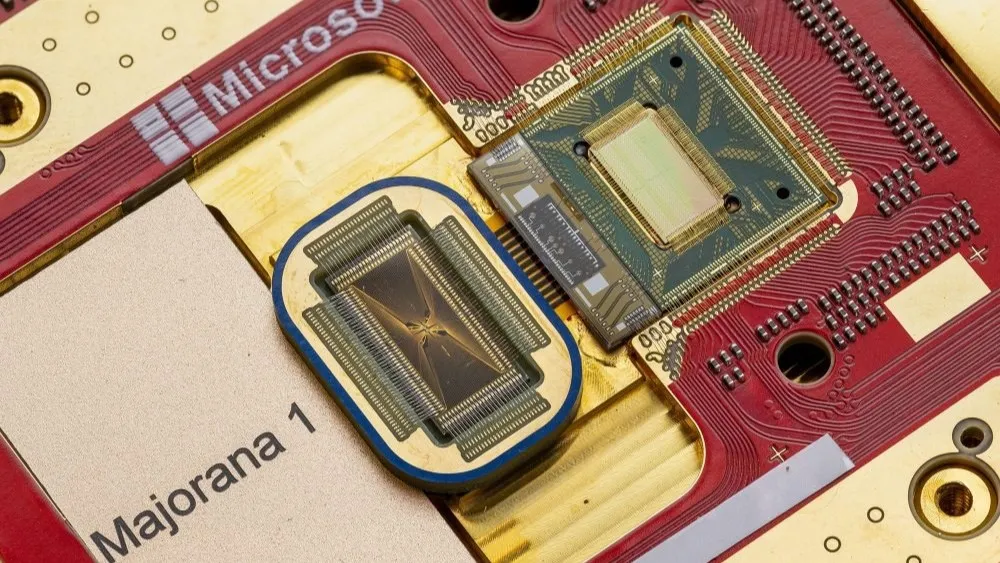
A newly announced chip from Microsoft could solve unsolvable problems, revolutionize quantum computing, and solve real-world problems that cannot be solved by the combined forces of every computer in the world combined. Those are bold claims, so you may think they're about a concept device or a look-ahead into what could be in a decade. But that's not the case. Microsoft announced a new chip called the Majorana 1 processor.
The processor paves the way to make a quantum computer in the near future, according to Microsoft CEO Satya Nadella. "We believe this breakthrough will allow us to create a truly meaningful quantum computer not in decades, as some have predicted, but in years," said Nadella on LinkedIn.
The particles needed for quantum computing do not exist in nature. In fact, they didn't exist at all until quite recently. Microsoft created a new material and architecture for quantum computing. The Majorana particles are key to Microsoft's approach to quantum computing.
“It’s one thing to discover a new state of matter,” said Microsoft technical fellow Chetan Nayak. “It’s another to take advantage of it to rethink quantum computing at scale.”
That new material is not a solid, liquid, or gas. Instead, it is a new state of matter. Nature has a newly published paper that explains topological qubits in more depth.
A breakthrough in quantum computing. Majorana 1 brings us closer to harnessing millions of potential qubits working together to solve the unsolvable—from new medicines to revolutionary materials—all on a single chip. #QuantumComputing #QuantumReady https://t.co/mpj8VwEQj0 pic.twitter.com/zlQoyoFURvFebruary 19, 2025
Microsoft's new chip creates a potential path to revolutionize several industries and solve real-world problems that cannot be addressed by current computing methods. The tech giant shared examples such as "breaking down microplastics into harmless byproducts or inventing self-healing materials for construction, manufacturing or healthcare." As you would expect from such a cutting-edge piece of technology, details about it are quite technical and have a lot of jargon. Here are some key terms that should help translate Microsoft's blog post:
- Quantum computer: A type of device that uses quantum states of matter to store and compute information.
- Qubit: The basic building blocks of quantum computers. They store information where information can be processed.
- Topoconductor: A new type of chip designed to make a path for creating quantum systems that can scale to a million qubits. Microsoft analogizes the topoconductor to the "transistor for the quantum age." It is a semiconductor that also acts as a superconductor.
- Topological state: A new state of matter that is not solid, liquid, or gas. Particles in this state are key to quantum computing.
- Majorana 1: The first Quantum Processing Unit (QPU) that is powered by a topological core.
The key here is the million qubit figure Microsoft refers to frequently. That threshold needs to be hit to scale computing to a point at which it can solve real-world problems.
“Whatever you’re doing in the quantum space needs to have a path to a million qubits. If it doesn’t, you’re going to hit a wall before you get to the scale at which you can solve the really important problems that motivate us,” said Nayak. “We have actually worked out a path to a million."
Microsoft has a video that breaks down quantum computing and Microsoft's efforts in the space and the Majorana 1 chip.