


Anyone who grew up gaming in the '80s, '90s, and early 2000s likely has fond memories of their CRT display. I know I certainly do; I can still smell the static coming off the PC screen as I sat way too close while enjoying games like Diablo 2 and Age of Empires 2.
Although Cathode Ray Tube (CRT) tech fell by the wayside a couple of decades ago as Liquid Crystal Display (LCD) tech became cheaper and more readily available, there are a lot of gamers who refuse to give up the nostalgia.
In fact, the r/crtgaming subreddit is a rather healthy community of more than 75,000 like-minded gamers who are keeping the CRT dream alive as they share their retro gaming setups, troubleshooting advice, sale listings, and preservation techniques. There are even some good ol' LAN parties that arise now and then.

I get the appeal of gaming on a CRT display. Old games are proven to look better on CRT screens because of how the games interact with the tech. Scanlines soften sharp, pixellated edges. The CRT glow is warm and inviting. And a lack of motion blur and input lag keeps old games feeling snappy.
Despite the efforts of tens of thousands of gamers who truly love CRT displays, the tech will eventually die out. Whether it's the cathode ray tube itself that pops or the electronics supporting it that fail, the number of CRT displays is on a constant downward trend.
New CRT displays are no longer produced (except for very specific cases), while LCD and OLED screens have become the new norm. For nostalgia gamers who refuse to give up on the tech, there's a new way forward. The CRT revival is real.
How are modern OLED displays helping drive a CRT comeback?

Gamers everywhere are passionate about their displays. The r/OLED_Gaming subreddit has some 436,000 members, and there's a specific crossover between the two communities that I'd like to highlight.
Organic Light Emitting Diode (OLED) displays have several benefits that make them great for CRT emulation. OLED displays generally have extra brightness, low input lag, high resolutions, and fast response times. But how exactly is CRT emulation achieved on modern hardware?
The answer is something I'd never considered until I took the CRT emulation plunge: dedicated video scalers that offer CRT vibes on OLED tech.
RetroTINK is one of the leading companies creating these video processors. RetroTINK's products act as an intermediary between your old gaming console or PC and a modern OLED TV, providing features you'd normally only get from a CRT screen. Scan lines, masks, warm phosphor glow; you get the idea.
With something like a RetroTINK-4K CE, you can enjoy your old games at a 4K resolution on an OLED display, all with your choice of CRT simulation effects enabled.
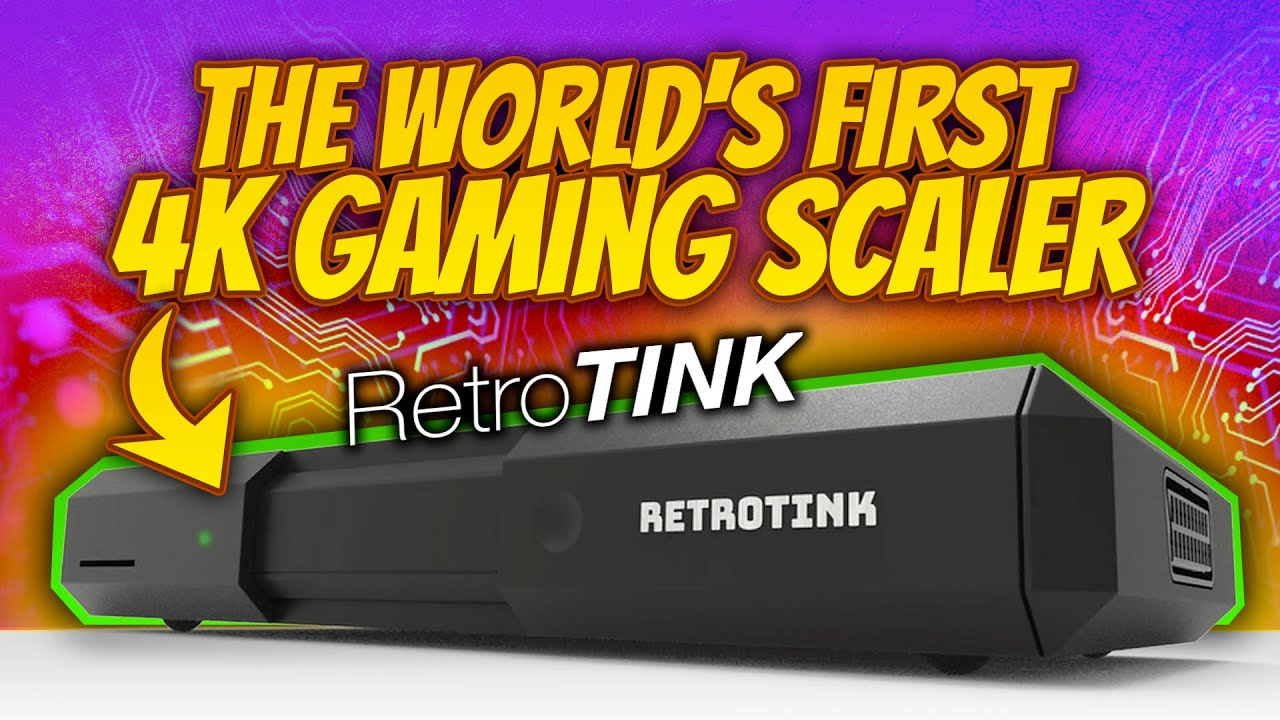
The results of using a RetroTINK with an OLED display speak for themselves, and there are plenty of video examples to be found.
Although it's often not a 1:1 comparison, there's really nothing else that can get you that CRT feel unless you are maintaining an actual CRT display.
CRT is still cheaper than OLED, but for how long?

The biggest downside to using something like RetroTINK to turn your OLED into a CRT is cost. The top-tier RetroTINK-4K Pro costs $835, with the RetroTINK-4K CE coming in at $530.
There are cheaper options that can deliver similar effects, but you're still looking at dropping anywhere from about $100 to $400.
Old CRT screens are usually quite cheap, and you might be able to haul one home from a garage sale (assuming your back is up to the lifting) without really putting a dent in your wallet. But as I mentioned, CRTs are becoming ever more rare. If collectors are the last bastion of the tech, prices will only go up as numbers dwindle.
CRTS also take up a lot of room. With an OLED panel and a video upscaler, you're getting double-duty out of your modern screen, and you can worry less about when the CRT is going to turn on for the last time.
Are you a CRT gaming aficionado? I want to know!
The world of retro gaming on CRT screens is only now just opening up to me, and I'm trying to decide if I should get something like a RetroTINK or if I should instead find a CRT and figure out how to maintain it properly.
I've held on to most of my old consoles, and I know it would be a blast to put together a PC designed to run all of the discs I still have from decades ago.
Have you also taken the CRT gaming plunge? What does your setup entail? If not, are you interested in the new emulation tactics for modern OLED TVs and monitors? Be sure to let me know in the comments section below!

Join us on Reddit at r/WindowsCentral to share your insights and discuss our latest news, reviews, and more.

