


Dell's new XPS 13 for 2026 delivers on many of the features that the MacBook Neo leaves behind, like a backlit keyboard, touch display, powerful ports, faster Wi-Fi, quad speakers, and a 120Hz display. This is the ideal laptop for students who prefer Windows, and anyone else who wants a sleek, thin, and modern PC.
Pros
- Backlit keyboard
- 2.5K display with 120Hz refresh rate
- Beautiful CNC-machined aluminum chassis lighter than Neo
- Faster ports, newer Wi-Fi/Bluetooth standards
- Quad speakers, facial biometrics
- More hardware options, strong Intel Wildcat Lake chips
Cons
- $599 price is for students only
- True performance and efficiency TBD

Apple's MacBook Neo starts at $599 for all buyers, but it comes with several blind spots that the XPS 13 fills in. Its A18 Pro chip is a marvel, offering strong performance and efficiency, and as long as you're OK with several drawbacks, it's the right choice for those who can't stand Windows.
Pros
- Gorgeous aluminum design
- Superb efficiency and strong performance
- Starts at $599 for everyone
- Touch ID biometrics
Cons
- No keyboard backlight
- Weighs more
- 60Hz display, no touch
- Slower ports
- 8GB RAM maximum
Dell unveiled its reimagined XPS 13 at Computex 2026, and thanks to an introductory $599 price for students, it was immediately likened to Apple's MacBook Neo.
Windows Central Senior Editor Zac Bowden and I both got a chance to go hands-on with the new XPS 13 in Taipei, and we both came away with a similar opinion: it's way better than either of us expected, and it's surely going to be a great Neo alternative for Windows fans.
So, how exactly does the new XPS 13 compare to the MacBook Neo? Here's what you need to know.
Dell XPS 13 (2026) vs. MacBook Neo: Specifications
Specifications don't tell the whole story, but they're a good place to start before I get into a broader explanation of the similarities and differences between the XPS 13 and MacBook Neo.
| Row 0 - Cell 0 | Dell XPS 13 (DX13260) |
Apple MacBook Neo |
CPU |
Intel Core 5 320, Intel Core Ultra 7 355 (post-launch) |
Apple A18 Pro |
GPU |
Intel Graphics (integrated) |
5-core (integrated) |
RAM |
8GB, 16GB, 32GB (Core Ultra only) LPDDR5x-7467 |
8GB LPDDR5 |
Storage |
256GB (post-launch), 512GB, 1TB (Core Ultra only) M.2 PCIe 4.0 NVMe SSD |
256GB, 512GB |
Display |
13.4 inches, 2560x1600 (2.5K), touch, 500 nits, 100% DCI-P3, DisplayHDR 400, 30-120Hz VRR, Dolby Vision, Eyesafe, anti-glare |
13 inches, 2408x1506 (219 PPI), 16:10 aspect ratio, 60Hz refresh rate, non-touch, 500 nits, Dolby Vision |
Wireless |
Wi-Fi 7, Bluetooth 6.0 |
Wi-Fi 6E, Bluetooth 6 |
Camera |
1080p + IR |
1080p |
Audio |
Quad speakers (8W total), Dolby Atmos |
Dual speakers, Dolby Atmos |
Battery |
52Wh, 800ED cells |
36.5Wh |
Ports |
2x USB-C 3.2 Gen 2 (WCL), 2x Thunderbolt 4 (PTL) |
One USB-C 3.2 (Gen 2), USB-C 2.0, 3.5mm audio |
Dimensions |
11.69 x 7.9 x 0.5 inches (296.9mm x 200.66mm x 12.7mm) |
11.71 x 8.12 x 0.50 inches (297.5mm x 206.4mm x 12.7mm) |
Weight |
2.2 pounds (1kg) |
2.7 pounds (1.23kg) |
Price |
From $599 (students) |
From $599 |
Dell's new XPS 13 has the features you want in a laptop

Much of the hype surrounding the new Dell XPS 13 has to do with its feature set. Namely, features that fill in the MacBook Neo's blind spots.
For example, the XPS 13 has a backlit keyboard. That's a feature you expect to have in a laptop in 2026, no matter the price point.
The XPS 13 has a 1080p webcam, just like the Neo, but it adds an IR sensor for facial recognition through Windows Hello. The Neo also offers biometrics, but only of the touch/fingerprint variety.
The XPS 13 doubles up the Neo's speaker count, totaling 8W of output, and both laptops come with Dolby Atmos tuning. The XPS 13 also has newer Wi-Fi 7 wireless connectivity, with the Neo falling back to Wi-Fi 6E.

Then there are the ports. While the Neo might still offer a 3.5mm audio jack, its main selection of USB-C 3.2 (Gen 2) and USB-C 2.0 isn't exactly generous. It supports only one external display at 4K/60Hz.
The XPS 13 with Wildcat Lake chip (Core 5 320) has dual USB-C 3.2 (Gen 2), and the XPS 13 with Panther Lake (Core Ultra 7 355) has dual Thunderbolt 4. If you plan on using your laptop with more than one external display, Dell's PC is the right choice.
The new XPS 13 is lighter than the MacBook Neo
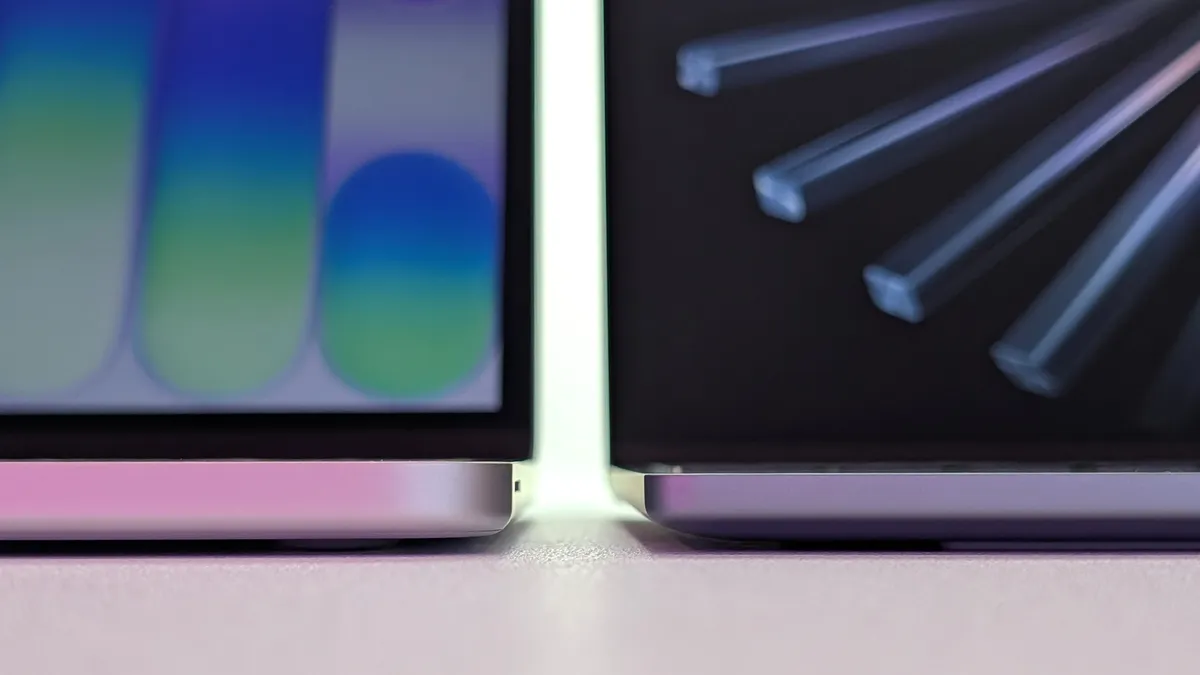
Like the MacBook Neo, the XPS 13 is built from aluminum and feels every bit as premium as its more expensive siblings.
When I first handled the XPS 13, I was impressed with how light it was. At just 2.2 pounds (1kg), it's significantly more portable than the Neo at 2.7 pounds (1.23kg).
The XPS 13 is just as thin as the Neo at 0.5 inches (12.7mm), but it does have a more compact footprint.
TL;DR? The new XPS 13 has more attractive features than the MacBook Neo, including a backlit keyboard, an IR camera, four speakers, and more powerful ports.
Dell's XPS 13 has a higher-res display with 120Hz refresh rate

Dell is also putting Apple behind it with the 13.4-inch display in the XPS 13. Not only is it slightly larger (by 0.4 inches) despite the XPS 13's smaller chassis, but it also has a higher resolution at 2560x1600 compared to 2408x1506.
The biggest difference, however, is in the refresh rate. The XPS 13 pushes all the way up to 120Hz and drops as low as 30Hz. It's all handled through a variable refresh rate that adjusts the screen based on how you're using the PC.
At 120Hz, you're getting far more eye comfort than the locked 60Hz refresh rate on the Neo. And at 30Hz, battery saving gets even better in the XPS 13.

The XPS 13's touch display hits about 500 nits of brightness and has VESA DisplayHDR 400 certification, as well as an anti-glare finish. It manages 100% DCI-P3 color reproduction, and it comes with Dolby Vision.
The Neo's display is not touch-enabled, but it does hit 500 nits of brightness and includes Dolby Vision certification.
TL;DR? The XPS 13's display is the superior option compared to the MacBook Neo, with a higher resolution and higher refresh rate.
Apple's A18 Pro chip has strong competition from Intel Wildcat Lake

Despite being aimed at budget devices, Intel's new Wildcat Lake CPUs offer respectable performance and efficiency that rival Apple's A18 Pro. I'll hold off on a deeper dive until we test the XPS 13 firsthand, but I can say that early Intel Core 5 320 benchmarks show a promising level of power.
In Geekbench 6, the Core 5 320 hits 2,575 single-core and 8,000 multi-core average scores, whereas the A18 Pro hits closer to 3,500 single-core and 8,500 multi-core.
In PassMark CPU tests, the Core 5 320 hits 3,853 single-core and 15,033 multi-core scores. The A18 Pro managed scores of 4,086 (single-core) and 12,837 (multi-core).
If you do need more power, the XPS 13 will also be available with the Core Ultra 7 355 post-launch. It's important to also point out that the XPS 13 comes with up to 32GB of RAM and up to a 1TB M.2 PCIe 4.0 SSD. So while the entry-level models take on the Neo, the higher-end models are much better cut out for advanced users.

Battery life will be a big point of contention, I'm sure, but for now, I don't have concrete XPS 13 numbers. I can say that Dell is using a larger 52Wh battery with 800ED cells (providing extra density without taking up as much space).
Dell is claiming up to 17 hours of battery life when streaming video. Apple claims about 16 hours of life for the same task. It should be a close comparison, and I wouldn't be surprised to see the Neo take the award for best battery life, even if it's a small margin.
TLDR? Dell's XPS 13 should put up a strong fight against the MacBook Neo's performance and battery life.
Dell XPS 13 (2026) vs. MacBook Neo: Which should you buy?
If you're a fan of Windows, Dell just gave you the perfect Neo competitor with the XPS 13. Students can pay the same $599 for a laptop with a superior display, more powerful ports, a keyboard backlight, facial recognition, quad speakers, and more.
If you're a regular buyer, the introductory price only jumps up to $699, and beyond that, there are options to boost RAM to 32GB and storage to 1TB.
Apple, I think, will hold the edge on performance and efficiency, at least until the Core Ultra 7 355 config of the XPS 13 becomes available post-launch. But I'll have more to share once we actually get an XPS 13 to test first-hand in the lab.
The XPS 13 for 2026 is expected to launch in June, while the MacBook Neo is available now.
Dell's new XPS 13 for 2026 delivers on many of the feature that the MacBook Neo leaves behind, like backlit keyboard, touch display, powerful ports, faster Wi-Fi, quad speakers, and 120Hz display. This is the ideal laptop for students who prefer Windows, and anyone else who wants a sleek, thin, and modern PC.
Apple's MacBook Neo starts at $599 for all buyers, but it comes with several blind spots that the XPS 13 fills in. Its A18 Pro chip is a marvel, offering strong performance and efficiency, and as long as you're OK with several drawbacks, it's the right choice for those who can't stand Windows.

Join us on Reddit at r/WindowsCentral to share your insights and discuss our latest news, reviews, and more.

