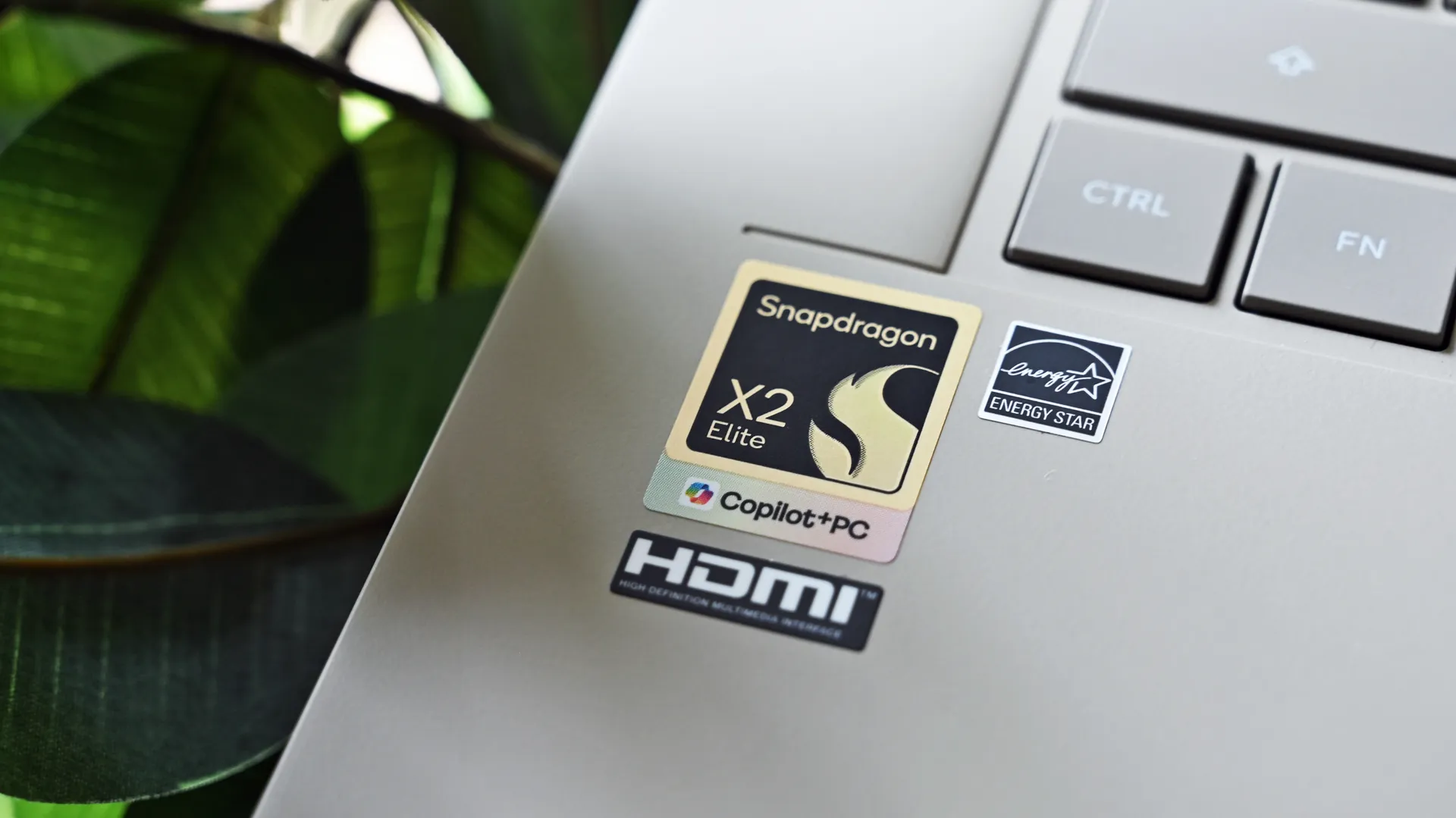
Last month, Windows Central exclusively covered a Signal65 report that showed Qualcomm's flagship Snapdragon X2 Elite Extreme outperforming Intel and AMD in a premium laptop showdown.
Now, a new follow-up study by Signal65 just published suggests the more important story may involve the version most people are likely to buy (Qualcomm’s Extreme chip is basically in one laptop, albeit an awesome one).
The independent testing firm's latest research examined the standard 18-core Snapdragon X2 Elite X2E-88-100 in Lenovo's Slim 7x, comparing it against Intel's Core Ultra X7 358H inside Dell's banger XPS 14 and AMD's Ryzen AI 7 445 in Lenovo's Yoga 7a 14.
This time, the focus shifted from large 16-inch flagship laptops to the increasingly important premium 14-inch category, where thermal constraints, battery life, and efficiency matter just as much as peak performance.
The most consistent finding in the data is that the Snapdragon system does not need to be set to a higher power profile to reach its top-tier performance, while the x86 systems do.
Signal65 Report
Luckily for Qualcomm, which commissioned the study, the results largely mirror the earlier Extreme-chip study. Qualcomm's platform led in CPU performance, AI workloads, productivity, and most battery-focused tests while also coming in significantly below the price of the Intel system evaluated.
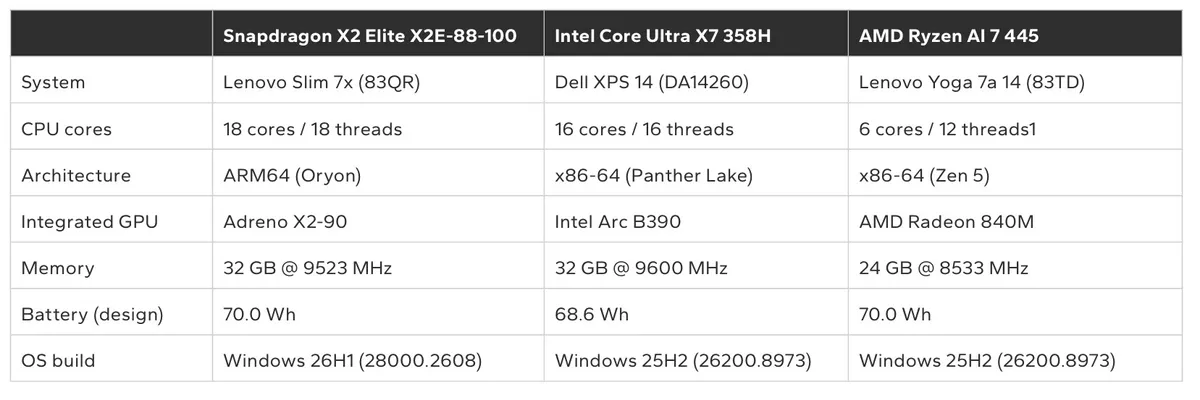
However, that does not mean Qualcomm won everything. Intel continues to hold meaningful advantages in graphics performance (exemplified to perfection in MSI’s latest handheld gaming PC), and the XPS 14 remains one of the most premium Windows laptops available today. Still, the latest findings strengthen the argument that Snapdragon's lead is no longer limited to a halo product, nor a quirk of its Extreme chip.
Let's dive into the numbers, and then break down what it really means, as there is some nuance here.
Strong CPU results, even without the flagship chip
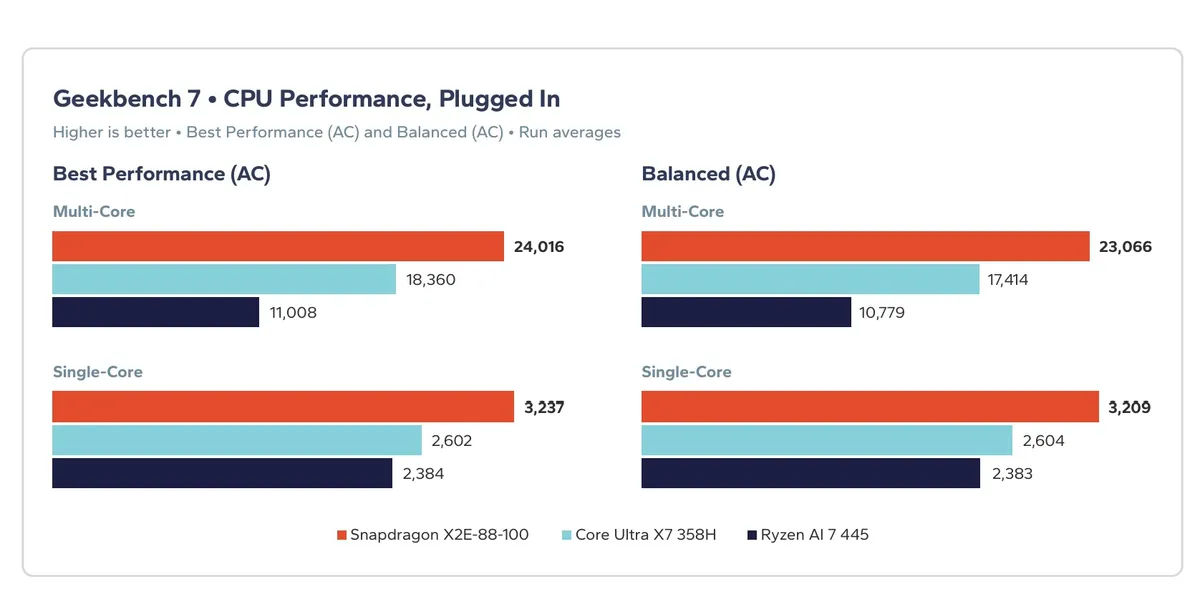
In Geekbench 7, the Snapdragon-powered Lenovo Slim 7x posted a multi-core score of 24,016, compared to 18,360 for the Intel-powered XPS 14. Single-core performance also favored Qualcomm, with a score of 3,237 against Intel's 2,602.
According to Signal65, that translates into leads of 31% and 24%, respectively, favoring Qualcomm.
Those numbers are especially notable because they are not solely the result of having more CPU cores. While Qualcomm's 18-core design certainly helps in heavily threaded workloads, the single-core advantage points to meaningful architectural gains from the second-generation Oryon design as well.
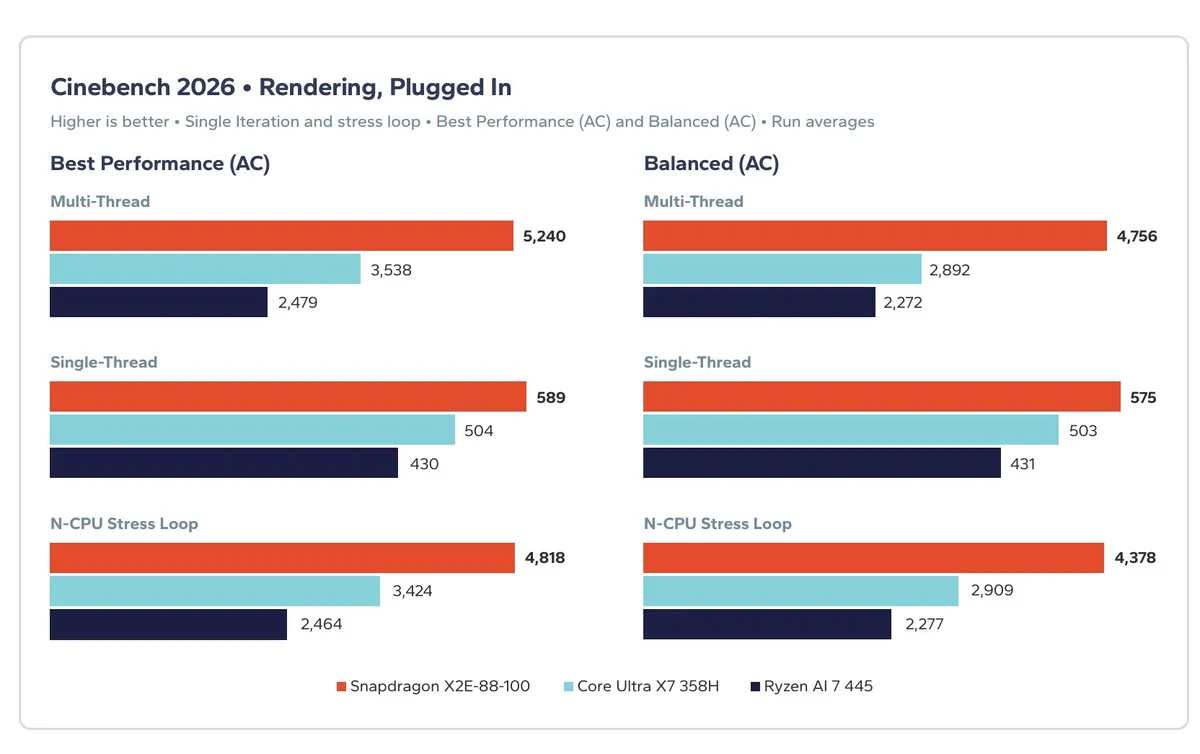
The company also maintained substantial leads in Cinebench 2026 rendering tests and across Microsoft's Office applications as measured by UL Procyon. In the productivity benchmark, Snapdragon led Intel by 10% in Best Performance mode and retained a smaller advantage in the default Balanced profile.
For buyers who spend most of their day in Word, Outlook, PowerPoint, Edge, and Teams, those productivity-oriented results may matter more than synthetic benchmark scores.
Qualcomm's AI advantage continues
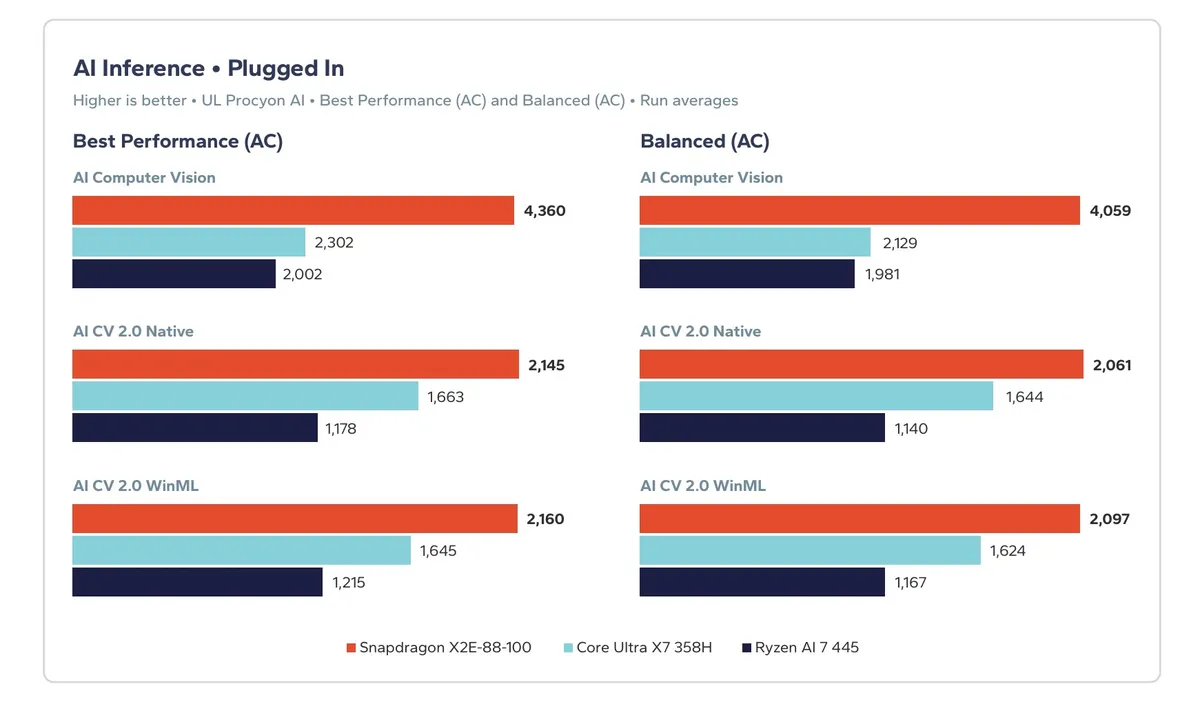
AI remains one of Qualcomm's strongest categories.
In UL Procyon AI Computer Vision, the Snapdragon system scored 4,360 compared to Intel's 2,302. Even in the newer AI CV 2.0 WinML benchmark, which routes through Microsoft's Windows ML framework rather than a vendor-specific path, Qualcomm maintained a lead of roughly 31% over Intel.
That distinction is important because it better reflects the way many Windows AI experiences are expected to work going forward. Basically, a benchmark that favors proprietary software optimizations is useful, but a benchmark that preserves the advantage through a common Windows layer is arguably more relevant.
Battery performance remains a major story

One of the headline findings from the earlier Snapdragon X2 Elite Extreme study was that Qualcomm gave up remarkably little performance when running unplugged. Qualcomm has been touting this advantage since the first gen of Snapdragon X.
The trend continues here.
Across six benchmarks, the Snapdragon system retained an average of 97% of its plugged-in Balanced-mode performance. Intel retained 95%, while the AMD system retained 74%. According to Signal65, the Snapdragon-powered laptop led every CPU, productivity, and AI benchmark tested on battery.
Critically, we must remember that OEMs, especially on Intel and AMD systems, have leverage on AC/DC performance choices, meaning a company like Lenovo could have its AMD system perform worse on battery ... in order to get better battery life. Companies do this to find what they think is a balance for their intended customer, even if the explanation is opaque.
I wrote about this AMD-throttling issue back in 2021, because I found it frustrating, deceptive, and disappointing. Not much has changed in 2026, apparently.

The battery life data was also favorable for Qualcomm, particularly because the three laptops used nearly identical battery capacities.
The Slim 7x (Qualcomm) lasted 16.1 hours in local video playback compared to 14.4 hours for the XPS 14 (Intel). In a Chrome browsing rundown, the Snapdragon laptop reached 11.2 hours versus 8.6 hours for Intel's machine.
There was one significant exception. Intel won the sustained Procyon Office battery test, posting 17.4 hours compared to Qualcomm's 14.3 hours. Signal65 argues that Snapdragon completed more work during that test, making the outcome more nuanced than a simple battery-life loss, but the result remains one of Intel's clearest victories in the report.
The XPS 14 deserves context

This is where I think the conversation becomes more interesting than benchmark charts.
The Snapdragon machine tested was a $1,999 Lenovo Slim 7x. The Intel competitor was a $2,749 Dell XPS 14. That $750 difference looms over nearly every chart in the report.
At the same time, it is difficult to discuss the XPS 14 purely as a processor comparison.
Dell's laptop is widely regarded as one of the most premium Windows notebooks on the market, with exceptional build quality, materials, industrial design, and one of the best displays available in the category. The Signal65 report acknowledges that these are comparisons of complete retail systems rather than isolated silicon measurements.

That matters because buyers are not choosing between just processors. They are choosing between laptops, aka the full package.
The display difference is particularly worth mentioning. Signal65 did not evaluate screen quality, but Dell's OLED-equipped XPS 14 has generally been considered one of the standout displays in the Windows ecosystem. Some buyers may reasonably decide that premium construction, display quality, and graphics performance justify paying more.
Others may look at a $750 premium and conclude that Intel's advantages are simply not large enough, which is fair, too. After all, we reviewed the Yoga Slim 7x back in May and gave it very high marks.
It's also worth pointing out that Dell's display is a VRR 120Hz at 2880 x 1800, while the Slim 7x is just 1920 x 1200 at 60Hz (both are OLED). Anyone worth their salt in comparing laptops and battery life knows the display is, by far, the number one draw on power, so while I do believe Qualcomm's chip here is better, a pinch of salt is needed for battery life results.
Intel still has a meaningful win: GPU

The strongest argument for Intel remains graphics, something the company has been working very hard at in recent years.
In 3DMark Steel Nomad Light, Intel's Arc B390 outperformed Qualcomm's Adreno X2-90 GPU by roughly 23% in both DirectX 12 and Vulkan testing. That's the same GPU powering the beastly MSI Claw 8 EX AI+ gaming handheld, which crushes AMD in the same space.
The practical consequence is that the Intel system's wins require the user to be plugged in and to have selected the right mode, while the Snapdragon system's wins do not.
Signal65 Report
For users who prioritize integrated graphics performance, gaming, or creative workloads that benefit from stronger GPU hardware, Intel still has a compelling case.
That advantage becomes harder to defend when price enters the discussion, which is why Signal65 ultimately concludes that Snapdragon delivers better performance per dollar across the tested systems. According to the study, Qualcomm's laptop delivered roughly 2.15 times Intel's value when normalized across selected CPU, rendering, and AI benchmarks.
Final thoughts
As with the previous report, this study was commissioned by Qualcomm, a fact readers should keep in mind. Signal65 remains an independent testing organization, but commissioned research naturally benefits from additional scrutiny.
Even with that caveat, the broader pattern is becoming difficult to ignore. I also trust the results.
The earlier Snapdragon X2 Elite Extreme report established that Qualcomm's flagship laptop chip could outperform competing Intel and AMD systems. This latest study suggests those advantages extend well beyond the top, hard-to-find SKU.
That may be the more consequential finding.
Flagship products are important for headlines, but the laptops that shape a market tend to be the mainstream premium systems people actually purchase. If Qualcomm can deliver strong CPU performance, class-leading AI results, competitive battery life, and lower pricing with a standard 18-core Snapdragon X2 Elite, the company has moved beyond proving a point and started building a sustainable competitive position in the Windows laptop market.

From my experience with both systems, I prefer Qualcomm since they usually run cooler and quieter, and my overall Windows 11 experience feels faster and smoother. That said, I have to admit Intel’s Core Ultra 3 series has really closed the gap — they’re genuinely impressive chips.
If anything, the bigger subtext with this story is just how far AMD has fallen out of this space. We recently covered how no modern Surface PCs opt for AMD, and it's not because of "not enough product" as Microsoft claims. It's because Microsoft knows they're not as good as what Intel and Qualcomm offer, full stop.
The bigger takeaway from these results is not that Qualcomm won another benchmark comparison. It's that Qualcomm appears to have successfully scaled its advantages beyond a halo product. Intel now faces a more difficult reality: competing not only against Snapdragon's fastest chip, but against the one that is likely to ship in far more laptops.

Join us on Reddit at r/WindowsCentral to share your insights and discuss our latest news, reviews, and more.