Apple made its MacBook Neo official on March 4, and its $599 introductory price tag is practically all that the laptop crowd could talk about for the rest of the week. Even Microsoft's former head of Windows (2009-2012), Steven Sinofsky, called the Neo a "paradigm-shifting computer" in a post on X.
Part of the Neo's appeal, aside from its budget pricing, is its straightforward design that promises some of the best repairability of any MacBook in recent memory. Industry repair pros at iFixit gave the Neo a 6/10 score, noting that "for Apple laptop repair, that counts as a real comeback."
Now, it's Framework founder Nirav Patel's turn to crack open the MacBook Neo to discover what's inside. Framework is home to the most repairable laptops around. You buy one of its PCs once, and you swap out parts as you need them.
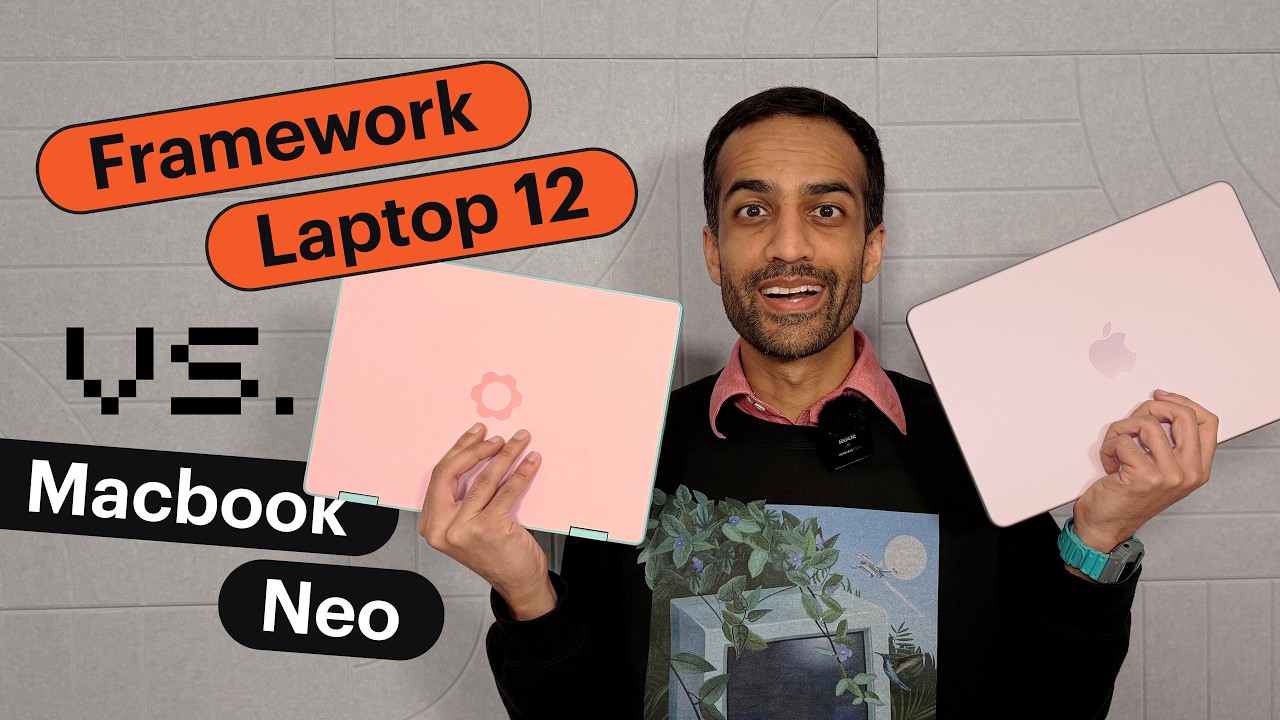
In the teardown video, Patel compares the convertible Framework Laptop 12 with the Neo, as they're similar in the sense that they're both sub-$1,000 PCs "that you can actually love."
The 33-minute video is well worth a complete watch, but let me sum up a few key points. During the teardown, it quickly becomes clear that the Neo isn't going to threaten Framework's upgrade supremacy.
Everything inside the Framework Laptop is clearly marked, and the frequent use of POGO pins makes it easy to quickly swap hardware. The Neo's internals are the complete opposite.

But that doesn't mean it can't be upgraded. The Neo's touchpad, battery, and speakers all can be removed fairly easily, and its ports can also be replaced should they receive damage.
The difference in repair philosophy becomes much clearer once Patel arrives at the mainboards. The Framework Laptop's cooling system, memory, and storage can all be replaced, and the CPU can also be changed with a new mainboard (which otherwise stays the same from generation to generation for easy updates).
The Neo's mainboard is a lot smaller, but it's not upgradeable. Whatever RAM and storage you choose at checkout is what you'll have for the rest of the laptop's life.
For the display, you'll likely have to replace the entire top assembly on the Neo if the screen takes damage. In Framework's Laptop, the screen can slide out of the chassis and be replaced.
Framework and Apple's contrasting laptop philosophies
Once the teardown is complete, Patel explains how his company's and Apple's philosophies differ despite both products appealing to schools and students. On Apple's side, Patel explains:
"A big part of it is to get in new MacBook users right from the start and then bring them into that walled garden that Apple has created for them. Once you're a MacBook Neo owner, you run out of storage space, it gets a bit too slow, you need more ports, you're in the MacOS world, maybe you'll buy that MacBook Pro, that MacBook Air at that $1,000 or $2,000 or $3,000."
Nirav Patel, Framework founder
Framework, Patel explains, is ideal for schools because "schools need repairability" to avoid e-waste and wasted money.
We want to eliminate that e-waste by making the product easy to use for as long as you want to. And of course, we don't want this to be a stepping stone on the path to other computers. If you've got a Framework Laptop, we want you to be able to continue to upgrade it so that it works well for you as long as you need to. That's our entire product philosophy.
Nirav Patel, Framework founder
What do you think about these contrasting laptop philosophies?
Patel wraps up the video by admitting that "there's a lot to love in both of these approaches," but I want to know what you think.
Is Apple on the right track here? Is it maybe testing the waters for a future where right to repair is more commonly signed into law? Let me know in the comments section below!

Join us on Reddit at r/WindowsCentral to share your insights and discuss our latest news, reviews, and more.