🏆 CES 2026 Awards: See which laptops, desktops, and other devices impressed us most this year.
Qualcomm is starting 2026 the same way it ended 2025: fast, confident, and very aware that the Windows PC world is shifting under everyone’s feet. At CES 2026, the company officially unveiled Snapdragon X2 Plus, the newest member of the Snapdragon X2 Series and the chip that’s poised to matter far more to everyday buyers than the flagship X2 Elite or the monster‑tier X2 Elite Extreme announced in September.

• Start: Tuesday, January 6, 2026
• End: Friday, January 9, 2026
• Where: Las Vegas, Nevada
• More info: CES 2026
I had the chance to see early X2 Plus laptops in person during a press preview in New York City back in early December. Qualcomm let us run live benchmarks on pre‑production hardware, and—much like last year’s X Plus rollout—the numbers lined up almost exactly with what the company is now publishing.
Qualcomm has earned a reputation for giving reviewers honest, reproducible performance data, and the X2 Plus continues that trend (I even had one major OEM tell me this off the record, noting how Qualcomm always delivers on time and never overpromises; and yes, that was shade thrown at Intel).
And that’s important, because this chip is aimed squarely at the mid‑to‑upper‑range Windows laptop market. In this segment, most people actually buy PCs, where businesses refresh fleets, and where OEMs need predictable performance and efficiency.
The X2 Plus is the platform that will show whether Qualcomm’s momentum in 2024 and 2025 was a flash in the pan or the beginning of a long‑term shift toward Arm‑based Windows machines.
From what I’ve seen so far, it’s the latter.
A “Plus” chip that feels a lot like an Elite

Qualcomm is shipping two versions of the X2 Plus: a 10‑core model and a 6‑core model. Both use the same 3nm process node as the X2 Elite, the same Oryon CPU architecture, the same Adreno X2‑45 GPU family, and—crucially—the same 80 TOPS Hexagon NPU. That last part is what makes this chip feel far more premium than its branding suggests.
The 10‑core version is the one most people will see in higher‑end ultrabooks and business machines. It hits up to 4.0GHz, carries 34MB of cache, and runs the GPU at a healthy 1.7GHz. The 6‑core version keeps the same peak frequency but trims cache and GPU clocks to hit more affordable price points. Both support up to 128GB of LPDDR5x memory and 152GB/s of bandwidth—numbers that matter more than ever as AI workloads scale.
This isn’t a “lite” chip. It’s a slightly leaner X2 Elite, and in some cases, it behaves like one.
Performance that punches above its weight

Qualcomm’s own numbers show the X2 Plus delivering up to 35% faster single‑core performance and up to 17% faster multi‑core performance than the previous‑generation Snapdragon X Plus. That’s a solid generational jump, but the more interesting story is how it stacks up against the competition.
In the NYC preview, we ran Geekbench 6.5 on the 10‑core model. The results matched Qualcomm’s claims: the X2 Plus outperformed Intel’s Core Ultra 7 265U and 256V processors at the same power levels, sometimes dramatically so. Qualcomm’s own ISO‑power comparisons show the X2 Plus delivering up to 3.5× the CPU performance of Intel’s Ultra 7 265U and up to 52% faster multi‑core performance than the Ultra 7 256V—while the Intel chips needed 4× to 4.6× more power to hit their peaks.
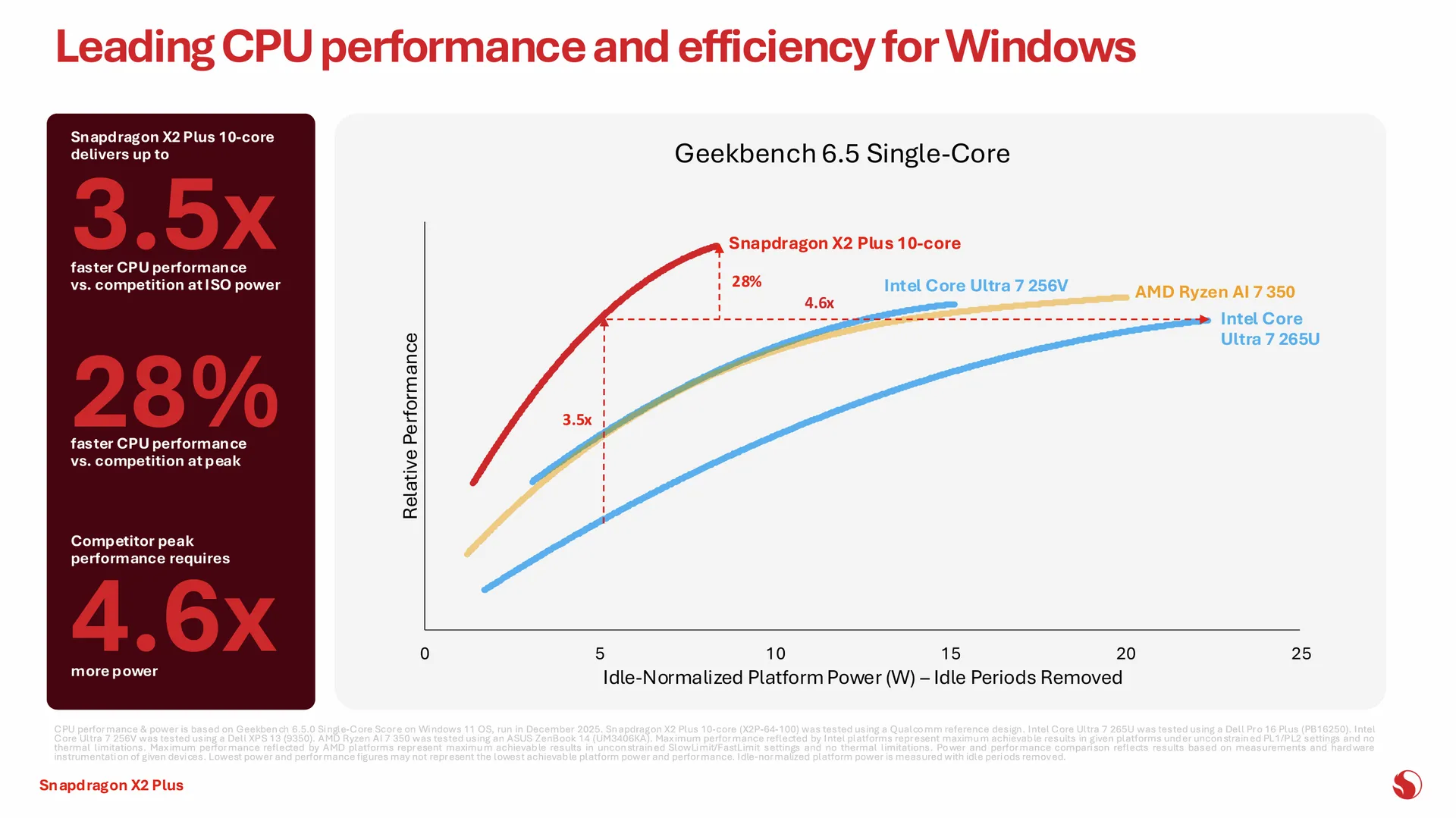
Image credit: Qualcomm
Geekbench performance of the new Qualcomm Snapdragon X2 Plus versus current on-market competition.
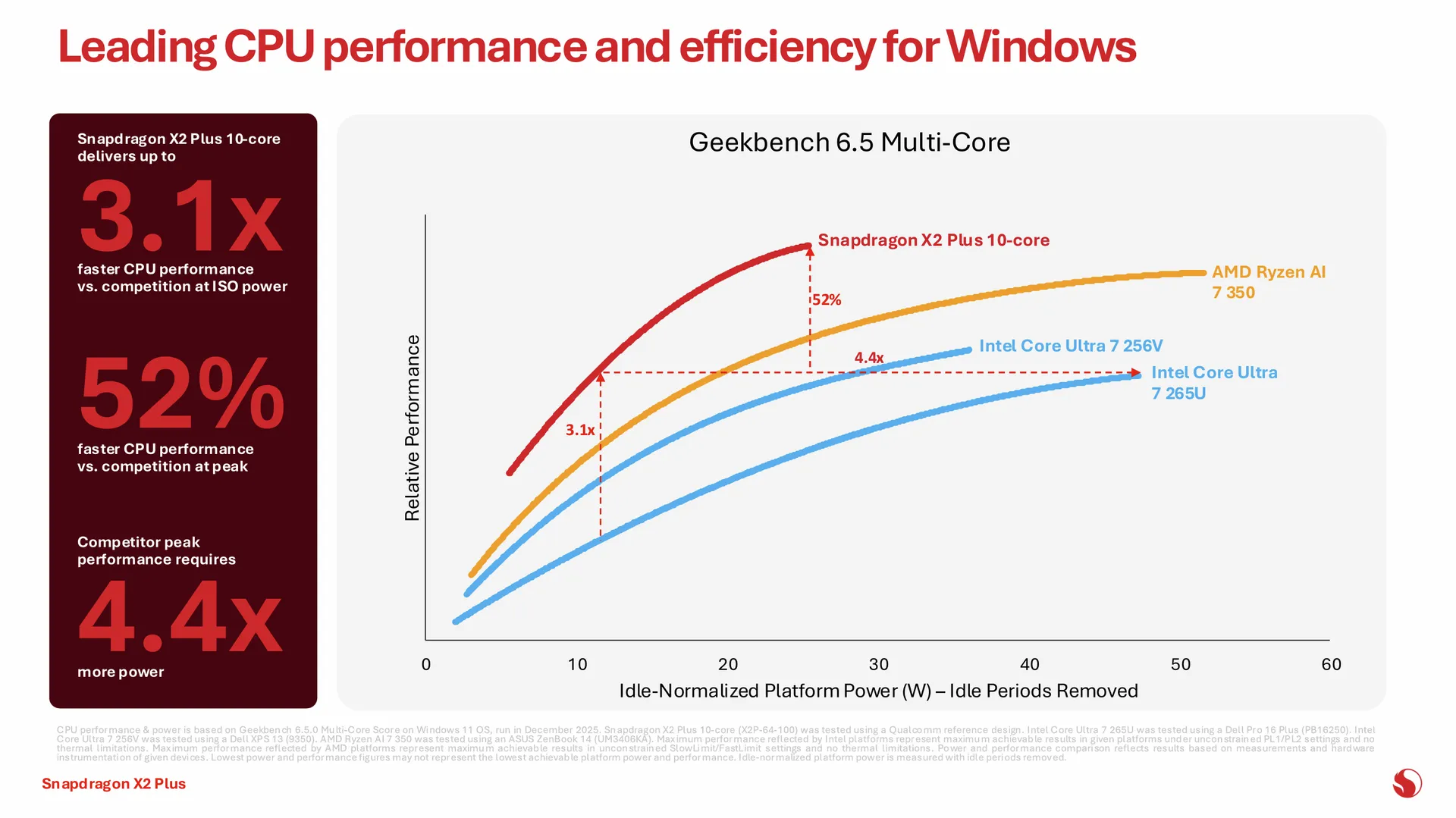
Image credit: Qualcomm
Geekbench performance of the new Qualcomm Snapdragon X2 Plus versus current on-market competition.
But here’s where we need to hedge. Intel is about to launch its Core Ultra 3 “Panther Lake” processors, built on the new Intel 18A process and featuring upgraded P‑cores, E‑cores, LP E‑cores, a significantly improved Xe3 GPU, and a fifth‑generation NPU.
Intel has been making real gains in efficiency and graphics performance, and Panther Lake is expected to push that further. So while the X2 Plus clearly beats some current Core Ultra 2 chips, the competitive picture will evolve quickly once Panther Lake laptops hit shelves in the coming weeks and months.
Still, Qualcomm’s advantage in sustained performance on battery remains a differentiator. In my hands‑on time, the X2 Plus behaved like the X Elite: no thermal drama, no sudden drops when unplugged, and no need for fans to spin up aggressively. That consistency is something Intel and AMD still struggle with in thin‑and‑light designs.
AI performance: Qualcomm keeps its lead (for now)

If there’s one area where Qualcomm continues to run laps around the competition, it’s the NPU (neural processing unit). The X2 Plus uses the same 80 TOPS Hexagon NPU found in the X2 Elite, and the benchmark results reflect that.
In UL Procyon AI Computer Vision, the X2 Plus scored 4193 — more than double the Intel Core Ultra 7 256V and over six times the Ultra 7 265U. Geekbench AI told a similar story, with the X2 Plus hitting 83,624 versus Intel’s 48,041 and 13,615.

Intel’s upcoming Panther Lake chips (aka Core Ultra 3) will include a new NPU rated around 50 TOPS, which will close the gap somewhat, but Qualcomm still holds the advantage in raw throughput and efficiency. And with Windows 11 leaning harder into on‑device AI — Cocreator, Automatic Super Resolution, Studio Effects, and the new wave of agentic AI features—OEMs want an NPU that can handle real workloads without spiking power draw.
For now, Qualcomm is still the company delivering that.
Battery life and real‑world behavior

Qualcomm is promising multi‑day battery life again, and based on what I saw in New York, that’s not marketing fluff. The X2 Plus reference designs ran cool, quiet, and consistently, even under sustained load. Qualcomm says the chip uses up to 43% less power than the previous generation while delivering higher performance, and the idle‑normalized power numbers back that up.
This is the kind of efficiency that changes how people use their laptops. It’s also the kind of efficiency that OEMs love, because it gives them more thermal headroom to build thinner, lighter designs without sacrificing performance
Why the X2 Plus matters more than the X2 Elite
The Snapdragon X2 Elite (and especially Elite Extreme) is the halo product—the one that grabs headlines and pushes the envelope. But the X2 Plus is the chip that will actually reshape the Windows PC market.
Most people don’t buy $1,500 laptops. Most businesses don’t deploy $2,000 ultrabooks. The X2 Plus is designed for the $799–$1,299 range, where volume lives and where Qualcomm can make the most significant impact (see the success of the ASUS Zenbook A14, one of our favorite laptops of 2025).
And it arrives at a moment when the PC industry is dealing with rising component costs, especially DRAM shortages and price spikes driven by AI data center demand. LPDDR5x is getting more expensive, not less, and OEMs need platforms that can deliver strong performance without requiring exotic cooling or high‑wattage designs. The X2 Plus fits that need perfectly.
It also brings Snapdragon Guardian remote manageability — out‑of‑band updates, lock‑and‑wipe, device tracking — to mainstream machines. That’s a huge deal for IT departments, as that's Intel's vPro playground right now, and removes one of the last barriers to Arm adoption in enterprise.
Concerns (and possible criticisms) of the Snapdragon X2 Plus?
I'm writing this to be even-handed, but honestly, there's not a lot of cons with the X2 Plus, at least not on paper, but here are a few.
Windows on Arm has improved dramatically, but some niche apps, older enterprise tools, and GPU‑heavy creative workflows may still run inconsistently under emulation (though this is really becoming the rare exception these days).
Gaming support is better than ever, yet anti‑cheat and certain titles remain question marks, although, again, Qualcomm and Microsoft are actively fixing this, and Fortnite is now in the can. And because the 6‑core X2 Plus has a slower GPU and lower multi‑core performance, there’s a real risk of OEMs muddying the waters with confusing configurations.
The competitive picture is also shifting fast. The X2 Plus clearly outperforms several current Intel Core Ultra 2 chips, but Intel’s upcoming Core Ultra 3 “Panther Lake” processors promise big jumps in efficiency, NPU performance, and especially graphics.
Add rising LPDDR5x memory prices and supply constraints heading into 2026, and some X2 Plus laptops could end up more expensive or under‑specced than buyers expect. These aren’t deal‑breakers, but they’re the practical realities that will shape how well the X2 Plus lands once devices hit shelves. And to be fair, the RAM situation affects AMD and Intel as much as Qualcomm.
Availability and what comes next

Qualcomm says the first Snapdragon X2 Plus laptops will ship in the first half of 2026, with announcements expected from all the major OEMs (many of which are being announced this week during CES 2026, including HP, Lenovo, and ASUS). Based on what I saw in New York, there will be a healthy mix of thin‑and‑lights, 2‑in‑1s, business ultrabooks, and even a few fanless designs.
But the bigger story is that Qualcomm now has a full stack: X2 Elite Extreme at the top, X2 Elite for premium ultrabooks, and X2 Plus for mainstream machines. I think this also means we should expect a more entry-level "Snapdragon X2" later this summer, possibly at Computex 2026. That would give Qualcomm an impressive range of price-per-performance offerings, and a slightly larger range than the original Snapdragon X series.
And with Intel preparing to launch Panther Lake and AMD readying its next wave of Ryzen AI chips, 2026 is shaping up to be the most competitive year for Windows laptops in a decade.
My personal experience with these new Intel, Qualcomm, and recent AMD chips is that we're all winners. This is some impressive silicon, including some serious GPU power, which may let enough people unshackle themselves from the increasingly cost-prohibitive NVIDIA.
The difference now is that Qualcomm isn’t the underdog anymore. It’s a real contender—and with the X2 Plus, it’s aiming directly at the heart of the market.

Is Snapdragon X2 Plus the moment Arm laptops finally break into the mainstream, or are you still waiting to see how Intel’s upcoming Panther Lake chips shake out before making the jump? I saw these machines running live in New York and came away impressed, but the real test will be how OEMs execute and how Windows handles the next wave of AI features.
Drop your thoughts below.
Are you ready to buy an Arm‑powered Windows laptop in 2026, or does x86 still have your trust? And if you’ve already used an X Elite machine, I’m especially curious how your real‑world experience lines up with Qualcomm’s claims. Let’s get into it!

Follow Windows Central on Google News to keep our latest news, insights, and features at the top of your feeds!